

Article Contents
What Is a Masterbatch?
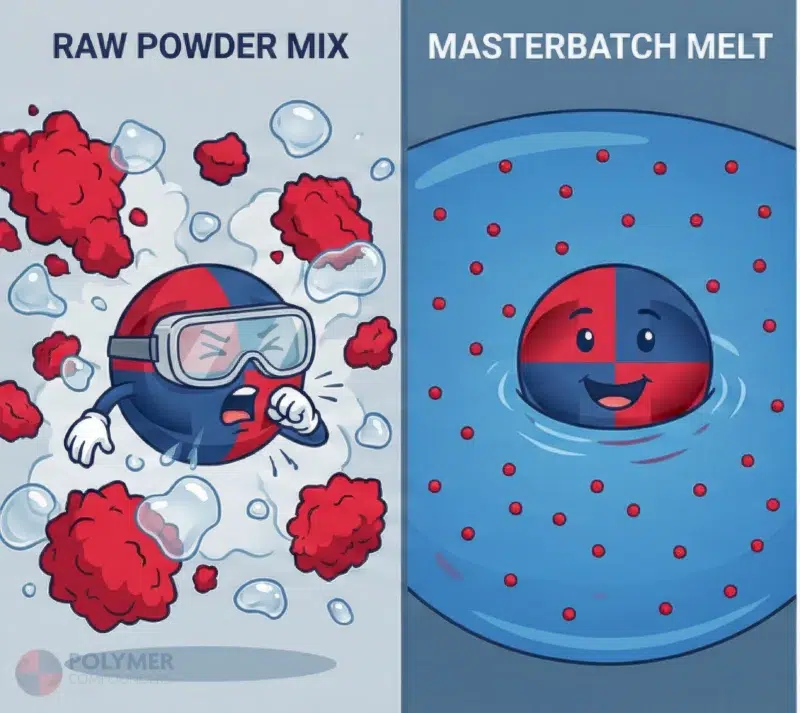
In the plastics industry, a masterbatch is a solid or liquid additive that colours plastics (colour masterbatch) or adds specific properties (additive masterbatch). In simple terms, it is a concentrated mix of pigments or additives combined with a carrier resin through heat. After processing, manufacturers cool the material and cut it into granules. As a result, processors can add colour or performance features to raw polymer in a controlled and efficient way. Instead of handling loose powders, they dose masterbatch directly into the process. This approach reduces mess, limits contamination, and improves consistency during production.
Core Components
A typical masterbatch formulation includes three main elements.
- First, the active ingredient provides the required function. This may be a pigment for colour, a filler such as calcium carbonate, or a chemical additive like a UV stabiliser or antistatic agent.
- Next, the carrier resin holds the active ingredient. To work correctly, the carrier resin must match the base polymer used in processing.
- Finally, dispersants and processing aids help spread the active ingredients evenly. In doing so, they support consistent performance in the finished plastic part.
Historical Context and Adoption
Before masterbatch became common, plastic converters often mixed raw pigment powders directly with resin. This method, known as dry blending, created dust and frequently led to uneven colour.
Over time, manufacturers introduced masterbatch as a cleaner and more reliable alternative. By using pelletised concentrates, processors improved dosing accuracy, reduced waste, and enhanced factory hygiene. As a result, masterbatch quickly became the standard method for colouring and modifying plastics.
Types of Masterbatch
Although many people associate masterbatch with colour, the industry classifies masterbatch types by function.
Colour Masterbatch: These are used primarily for aesthetic alteration. They range from simple primary colours to complex formulations involving pearlescent or metallic finishes.
- Tailor-made colours: Formulated to match specific Pantone or RAL references.
- Universal masterbatches: Utilise a carrier system compatible with various base resins, though often with trade-offs in mechanical properties.
White and Black Masterbatch: Due to their sheer volume, these are often categorised separately from standard colours.
- In most applications, white masterbatch contains Titanium Dioxide (TiO₂). It provides opacity, whiteness, and brightness. It is heavily used in packaging, films, and blow moulding.
- The Definitive Guide to Masterbatch: Chemistry, Processing, and Application
Additive Masterbatch: These modify the plastic’s physical or chemical properties rather than its appearance. Common examples include:
- UV Stabilizers: Prevent degradation from sunlight.
- Antistatics: Prevent static electricity buildup (crucial for electronics packaging).
- Slip Agents: Reduce surface friction (essential for allowing plastic bags to open easily).
- Flame Retardants: Inhibit or delay combustion.
- Antioxidants: Prevent polymer degradation during high-heat processing.
Effect Masterbatch: These are niche formulations designed to mimic other materials or textures, such as wood grain, stone, marble, or glitter effects, often allowing plastics to replace more expensive or heavier natural materials.
How Masterbatch Is Manufactured
In practice, masterbatch production uses a compounding process that prioritises dispersion. The goal is to separate pigment agglomerates and coat individual particles with the carrier resin.
The Production Process
-
First, pigments, additives, and the carrier resin are weighed precisely. At this stage, they may be premixed in a high-speed mixer to help the fine powders adhere to the resin pellets using wetting agents.
-
Next, the mixture is fed into an extruder, typically a twin-screw extruder. During extrusion, the shear force generated by the screws melts the resin and breaks down pigment agglomerates. This step is critical for quality, as insufficient shear can result in specks or streaks in the final product.
-
Once the melt is homogeneous, the molten material is extruded through a die and then cooled, usually in a water bath, before being cut into pellets.
-
Finally, the pellets are sieved to ensure uniform size. As a result, they flow consistently in the customer’s dosing equipment during downstream processing.
Key Quality Variables
- Dispersion: How well the pigment is broken down. Poor dispersion leads to “specking.”
- Compatibility: The carrier resin must blend with the end-user’s base resin without causing delamination or phase separation.
- Moisture Content: Masterbatches must be dry; moisture can cause processing defects such as “splay” (silver streaks) in injection moulding.
How Masterbatch Manufacturers use / processors use Plastic Processing
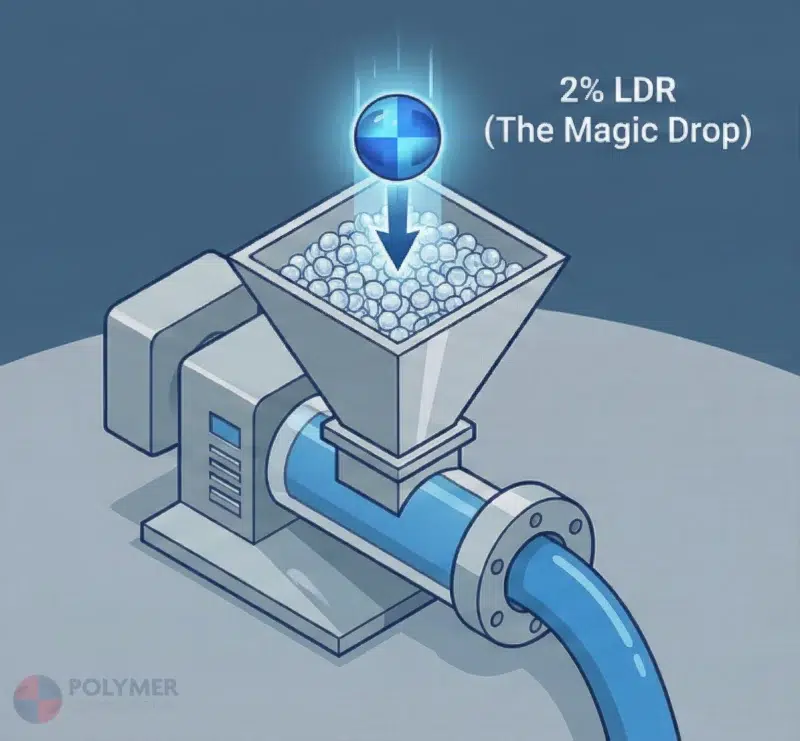
During processing, operators add masterbatch to the base polymer at the let-down ratio (LDR). The LDR is the percentage of masterbatch required to achieve the desired colour or property.
Injection Moulding and Extrusion
In a typical conversion scenario:
- Dosing: The converter fills the machine hopper with natural (uncoloured) base resin.
- Feeding: A dosing unit dispenses a specific percentage of masterbatch (e.g., 2% to 5%) into the machine throat along with the base resin.
- Plasticisation: The machine’s screw melts the base resin and the masterbatch. The screw rotation mixes the two melts together.
- Forming: The uniform melt is injected into a mold or extruded through a die.
Processing Considerations
- Screw Design: Standard injection-moulding screws are designed for melting and pumping, not for intensive mixing. Therefore, the masterbatch must be easily dispersible.
- Let-Down Ratio Accuracy: If a masterbatch is designed for a 2% LDR, dosing at 1% will result in weak colour or insufficient UV protection; dosing at 5% wastes money and may degrade mechanical properties.
Applications and Use Cases
Masterbatch is ubiquitous across the polymer value chain.
| Industry | Typical Application | Role of Masterbatch |
| Packaging (Rigid) | Bottles, Caps, Containers | FDA-compliant colours, slip agents for cap release, antistatics to repel dust on shelves. |
| Packaging (Flexible) | Food films, Shopping bags | Antiblocker additives to prevent layers sticking, for opacity, antioxidant for heat stability. |
| Agriculture | Mulch films, Greenhouse films | High-performance UV stabilizers to withstand years of sun exposure; infrared absorbers to control heat. |
| Automotive | Interior trim, Under-hood parts | Colour consistency for aesthetic parts; UV stability for dashboards; structural additives for strength. |
| Construction | Pipes (HDPE/PVC), Profiles | Carbon black for UV resistance in outdoor pipes; colour coding for utility identification (e.g., blue for water, yellow for gas). |
| Electronics | Cable jacketing, Housings | Flame retardants for safety compliance; colour coding for wiring systems. |
Advantages of Masterbatch
For many processors, masterbatch is the default choice for coloration and additivation due to distinct operational advantages.
- Handling and Cleanliness: Handling pellets eliminates airborne dust associated with powder pigments. This reduces contamination risks in the factory and protects worker health.
- Inventory Flexibility: A converter can stock large silos of cheap, natural resin and a small inventory of different masterbatches. This allows them to switch colours quickly without holding stock of pre-coloured resins.
- Consistency: Under controlled conditions, manufacturers produce masterbatch with consistent quality. This ensures precise additive concentration, offering better batch-to-batch repeatability than manual powder mixing.
- Shelf Life: The active ingredients are encapsulated in resin, protecting them from moisture, oxidation, and degradation during storage.
Limitations and Trade-Offs
Whilst convenient, masterbatch does not suit every processing scenario.
Contextual Note: Recycled Content Considerations
Quantifying and maintaining quality with recycled content introduces variables to masterbatch formulation. Compatibility with highly variable recycled feedstocks is a factor when assessing circularity goals.
- Dispersion Limits: If the converter’s machine has poor mixing capability, or if the let-down ratio is too low (e.g., <1%), the masterbatch may not mix evenly. This results in colour streaks or uneven additive distribution.
- Compatibility Issues: The carrier resin in the masterbatch is a “foreign body” to the base resin. If incompatible (e.g., a PE carrier used in ABS processing), it can cause peeling, delamination, or reduced impact strength.
- Cost at High Volume: For very large production runs of a single colour, buying masterbatch and natural resin separately is often more expensive than buying pre-compounded (pre-coloured) material.
- Thermal History: The additives in the masterbatch have been heated twice (once to make the masterbatch and once to make the part). For heat-sensitive additives, this can reduce efficacy.
Masterbatch vs. Polymer Compounding
This is the critical decision point for engineers and sourcing managers.
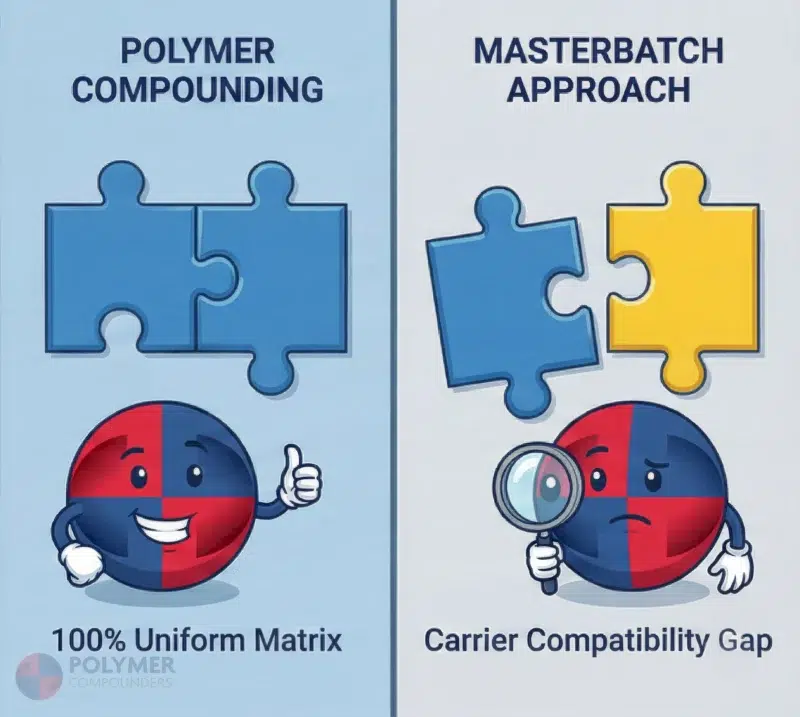
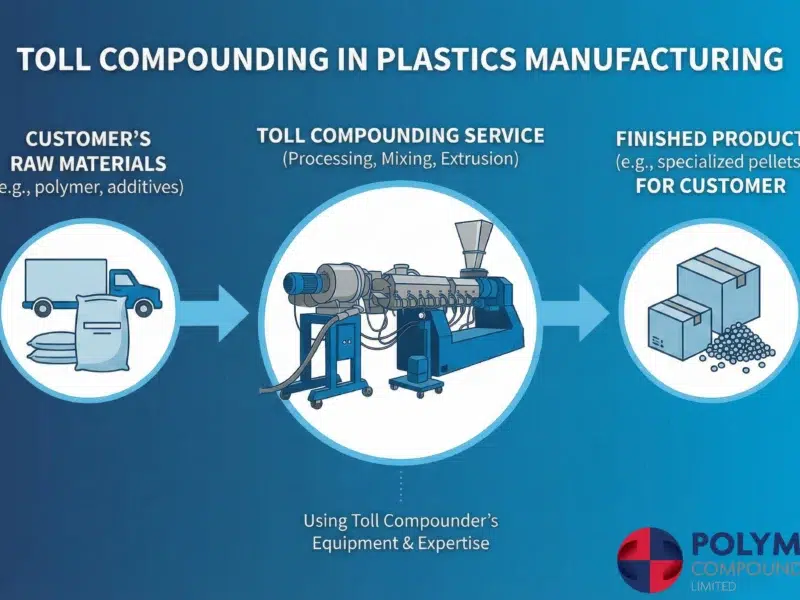
Polymer Compounding involves melting the base resin and intimately mixing pigments/additives in a twin-screw extruder to create a “ready-to-use” material.
Masterbatch involves mixing a concentrate into the base resin at the moulding machine.
Comparison Framework
| Feature | Masterbatch Approach | Pre-Compounded Resin |
| Dispersion Quality | Dependent on the moulder’s screw and mixing capability. | Excellent. Achieved via high-shear extrusion during manufacturing. |
| Material Properties | Slight risk of degradation due to carrier resin dilution. | Optimized. The matrix is uniform with no foreign carrier resin. |
| Flexibility | High. Easy to change colors on the fly. | Low. Must switch purely to the new material. |
| Inventory | Low. Stock base resin + small bags of MB. | High. Must stock full volume of every specific colour/grade. |
| Cost | More economical for short-to-medium runs and multiple colors. | More economical for high-volume, single-color/spec runs. |
| Accuracy | Relies on dosing equipment accuracy. | Guaranteed by the compounder’s Certificate of Analysis (CoA). |
Decision Rule: As a general rule, use masterbatch for flexibility, standard colours, and commodity applications. Use Compounding for critical engineering applications, high-performance requirements, or when the “foreign” carrier resin of a masterbatch would compromise the structural integrity of the part.
Industry Trends and Strategic Considerations
The masterbatch sector is evolving in response to environmental and technical pressures.
Industry Context: Sustainability Frameworks
Regulations such as the EU’s PPWR are increasing the focus on sustainability requirements. This has led to industry discussions about masterbatch pigments compatible with automated sorting systems, such as NIR-detectable blacks, and the development of compostable carriers.
Sustainability and Circular Economy
- Biopolymer Carriers: Development of PLA or PHA-based masterbatches to ensure that biodegradable plastics remain fully compostable after coloration.
- Recycling-Friendly Additives: Near-Infrared (NIR)- detectable black masterbatches that enable automated sorting systems to identify black plastics (which traditionally absorb NIR and appear invisible to sorters).
Liquid Masterbatch
For specific applications like PET blow moulding, liquid colour is gaining traction. It offers superior dispersion and dosing accuracy at very low let-down ratios (<0.5%), though it requires specialised dosing equipment.
High-Concentration Loading
Manufacturers are pushing to increase pigment loading in masterbatches (up to 80% active content). This reduces the amount of carrier resin introduced into the final product and lowers logistics costs.
How Decision-Makers Should Evaluate Masterbatch
When selecting a masterbatch supplier or deciding on a material strategy, do not rely solely on price per kilogram. Use this neutral evaluation framework:
Compliance Considerations
With ongoing regulatory updates on substances in food-contact packaging, vetting masterbatch suppliers for robust compliance data is a key component of corporate risk management.
- Carrier Compatibility: Confirming the carrier resin composition ensures it matches the base polymer (e.g., PE carrier for PE pipe).
- Let-Down Ratio (LDR) Efficiency: A cheaper masterbatch with a 5% LDR is often more expensive in use than a premium masterbatch with a 1% LDR. Calculating the cost per part rather than the cost per kilo provides a more accurate comparison.
- Regulatory Compliance: Verification that the formulation meets relevant standards, such as FDA, REACH, or RoHS, is critical if the application involves food contact or medical use.
- Heat Stability: Reviewing the masterbatch processing temperature window is important. If processing occurs at but the pigment degrades at, colour shifts may occur.
Evaluation Summary
Optimising material usage often involves a comparative cost-benefit analysis. Comparing current resin and masterbatch prices allows for the determination of a precise break-even point between using Masterbatch vs. Pre-Compounded material for specific applications.
Sources & Further Reading
- [1] European Commission. (2025). Regulation (EU) 2025/40 on Packaging and Packaging Waste (PPWR). Official Journal of the European Union.
- [2] Henderson, B. (2025). EU Regulation Limits PFAS in Food Packaging. Food Safety Magazine.
- [3] Savannah River National Laboratory. (2023). Fluoropolymer Processing Aids Used in Polymer (Non-fluorinated Polymer) Processing. US Department of Energy.
- [4] Soomro, S.S., et al. (2025). Quantification of recycled content in plastics: a review. Science of The Total Environment.
- [5] Tumu, K., et al. (2023). Global plastic waste recycling and extended producer responsibility laws. Journal of Environmental Management.
- [6] Hopewell, J., Dvorak, R., & Kosior, E. (2009). Plastics recycling: challenges and opportunities. Philosophical Transactions of the Royal Society B: Biological Sciences.
- Black Masterbatch: Based on Carbon Black. Aside from colouring, carbon black is a potent UV absorber and is essential for agricultural films, pipes, and automotive parts requiring weatherability.